
Sandusky City Directory Collection Shelf
The Sandusky Library Archives Research Center identifies its city-directory holdings as running from 1855 to the present, with gaps. That is a valuable collection range, but it is not a promise of an unbroken annual run. Confirm the physical volume for every needed year. The Library is the primary local route for older printed sources, with reference help, work space, reader-printers, a copier, and noncirculating archival material. Its main branch is at 114 W. Adams Street; its posted Archives Research extension is 6037.
| Directory source | Documented years | Holding route | Best use |
|---|---|---|---|
| Sandusky city-directory collection | 1855 to present, with gaps | Sandusky Library Archives Research Center | Local printed name and address research |
| W. D. Root, City Guide and Business Directory | 1855 | Identified by Erie County Historical Society resources | Earliest identified local volume |
| W. M. Lawrence & Co. directory | 1915 | Sandusky Library collection and Library history article | Alphabetical listings and street census |
| National Archives microfilm listing | 1927-28, 1930-33, 1935-36 | National Archives city-directory list | Selected-year federal microfilm lead |
The collection is strongest when each directory is treated as a time-stamped publication. A missing name can mean the relevant volume is absent, a spelling differs, the person was not listed, or the household changed. It does not settle the reason by itself.
See the Archives Research Center source before a visit.
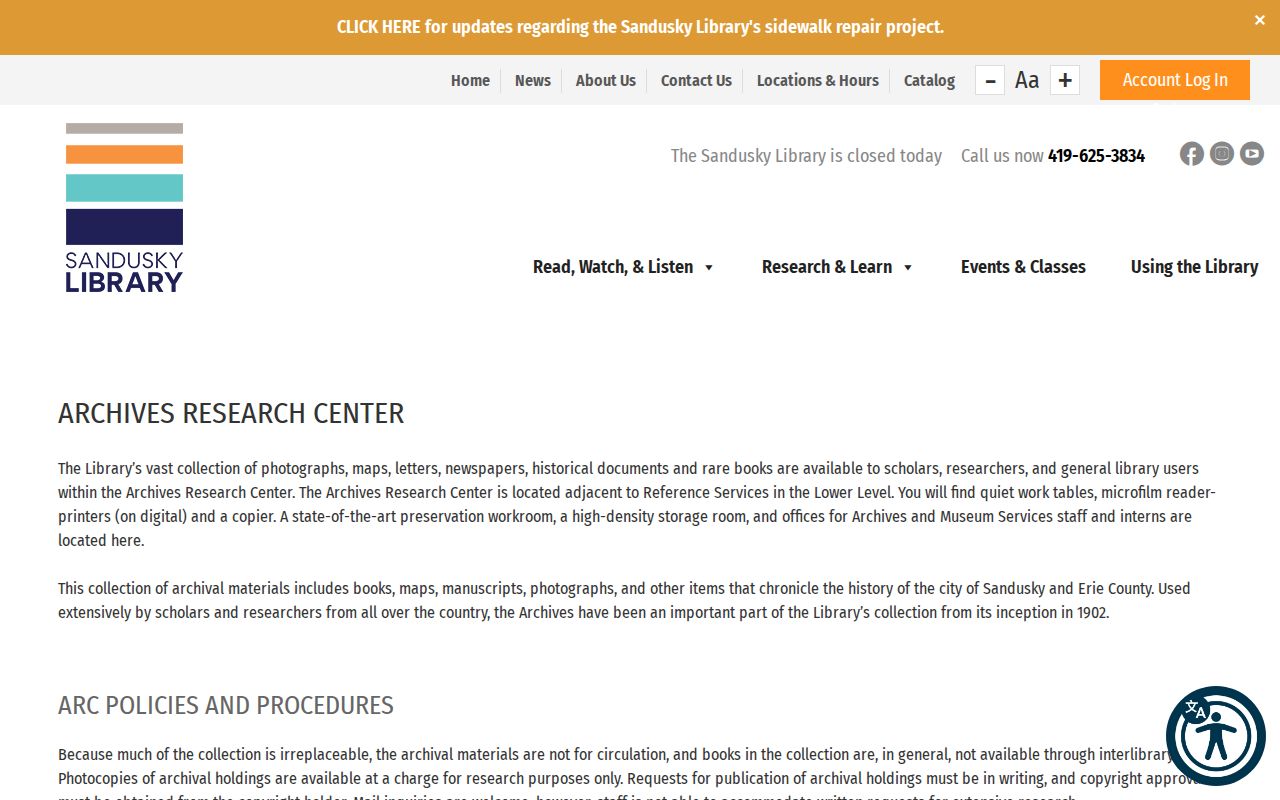
The Center is the local access point for the directory shelf as well as maps, manuscripts, photographs, newspapers, rare books, and related Erie County material.
Sandusky City Directory Begins in 1855
The earliest identified Sandusky city directory is W. D. Root's 1855 City Guide and Business Directory: First Annual Issue, printed at the Steam Press of Bill, Cooke & Co., Register Office. The Erie County Historical Society's Sandusky resources identify that volume and note that it opens with a contemporary town history. It is an early local source, not a complete record of everyone who was in the area.
Sandusky became the Erie County seat after Erie County was created in 1838 from northern Huron County. For a clue earlier than the county's creation, use the relevant earlier geography and custodian rather than assuming later county filing practice applies. The Library's directory range and the County's government files therefore answer different historical questions.
View the Historical Society resource that documents the early directory.
That local-history route helps place a directory volume in context, while the printed entry remains the evidence for a particular year.
Reading a 1915 Sandusky City Directory
The Library's account of the 1915 W. M. Lawrence & Co. volume provides a specific reading key. Its alphabetical personal and business listing can show a name, street address, telephone number, and often an occupation. Other pages identify officials, companies, organizations, religious bodies, and office-building listings. These are printed statements for 1915, so preserve the wording and do not turn an old notation into a claim about a modern household.
| Alphabetical entry | Records the printed name, address, telephone listing, and often occupation or business detail. |
|---|---|
| Italicized name | Means owner in this 1915 directory's notation system. |
| Colon and semicolon | A colon means wife of the preceding person; a semicolon introduces children. |
| Cross and double vertical marks | Mark children under 21 and under 16, respectively, in the source's own key. |
| Street census | Lists streets alphabetically and gives a household head, spouse, and children at printed addresses. |
- Street census
- The address-organized portion of the 1915 book, found on pages 245 through 415, rather than an all-years reverse directory.
- Householder
- The person printed as head of a household in a source entry. It does not independently prove legal residence beyond that year.
- Abbreviation key
- The volume's own explanation of symbols and short forms. Transcribe it with the entry so later readers can check the interpretation.
The Library's 1915 directory article explains this source-specific notation.
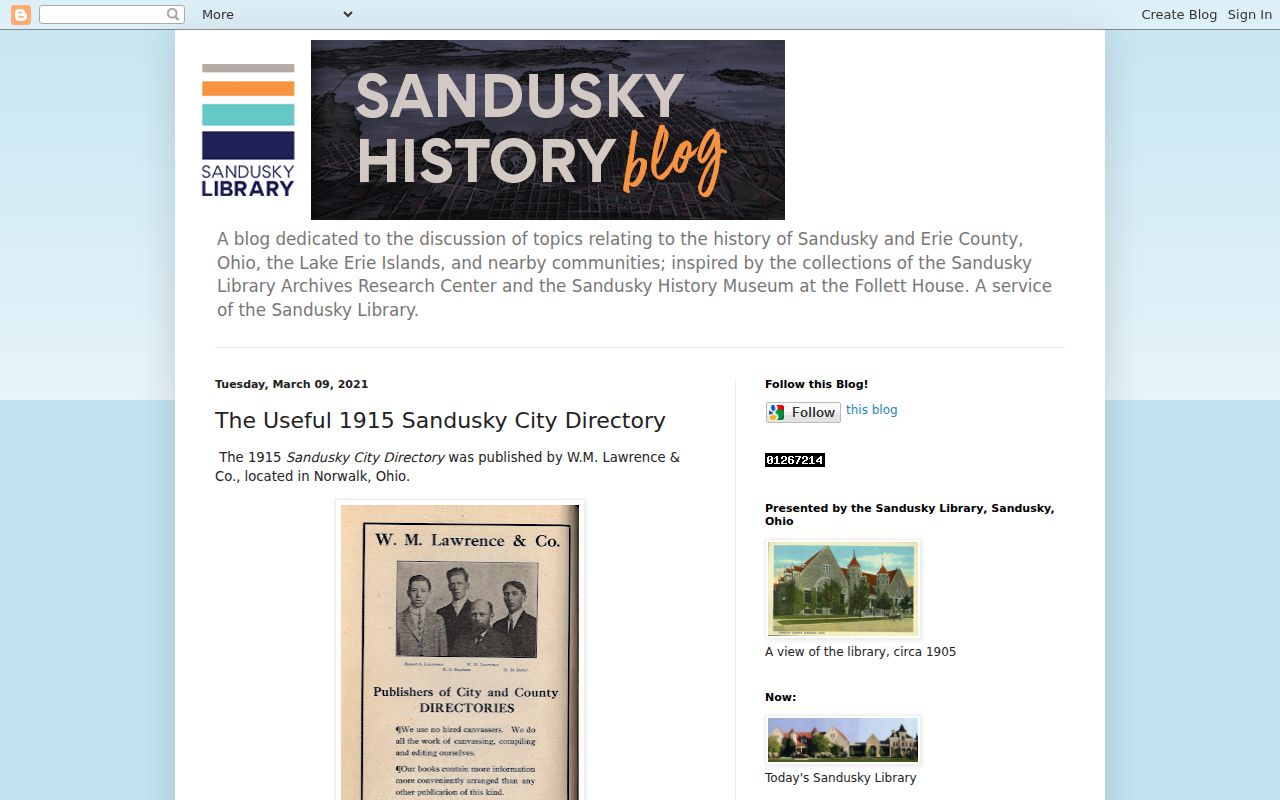
The notation is useful precisely because it has a documented key. Keep italic type and punctuation in research notes instead of flattening them into assumptions.
Sandusky Directory Street Census, 1915
The 1915 street census makes one volume unusually useful for a confirmed address. Pages 245 through 415 list streets alphabetically, then print the household head, spouse, and children at an address. It works as a dated, local reverse-directory substitute, not as a current address roster and not as proof for years the book does not cover. Compare its printed address with a deed, parcel, map, or newspaper dated near the same event.
For selected later years, the National Archives city-directory microfilm list identifies Sandusky reels for 1927-28, 1930-33, and 1935-36. Those selected microfilm years complement the Library's local collection. They should not be presented as a full series.
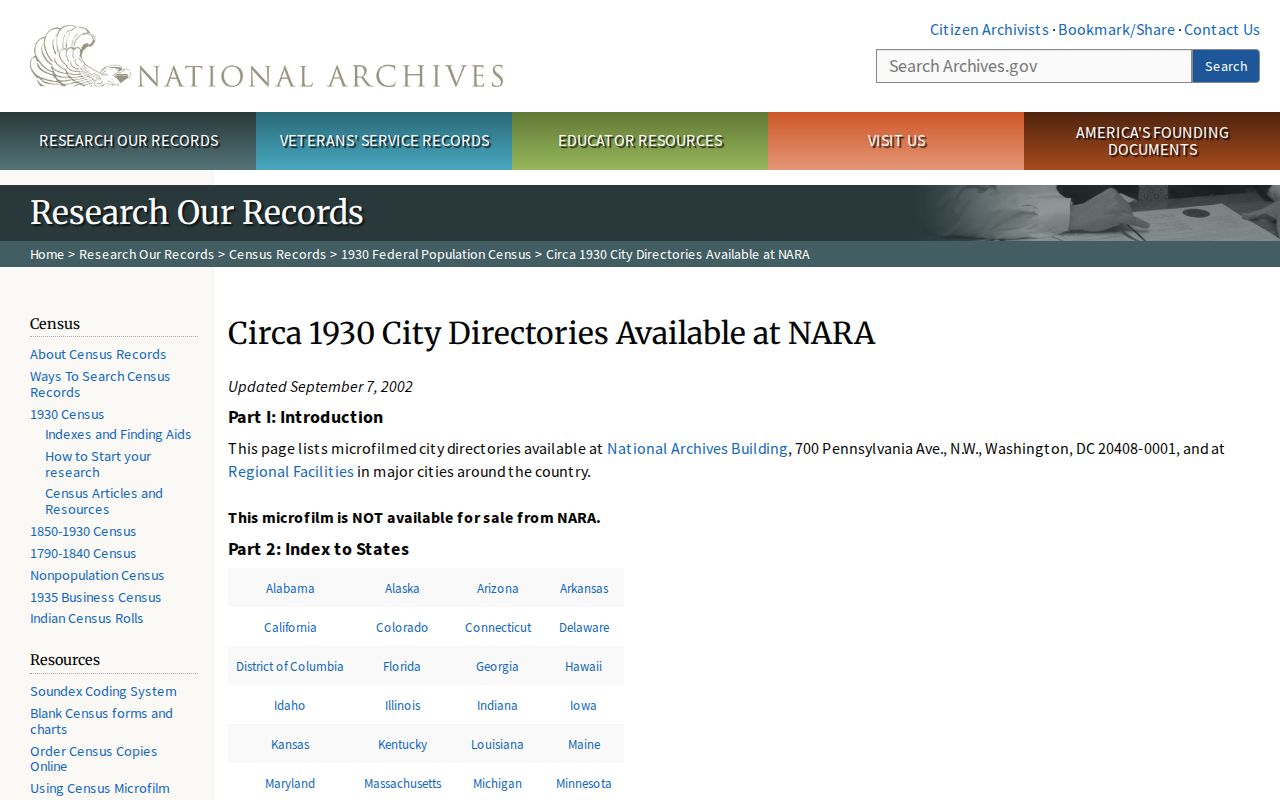
The federal listing is a second route for specified years; it does not replace checking the Library's holdings for the directory year needed.
Trace Sandusky City Directories Across Years
A household trail needs exact transcription and a gap-aware comparison. Start from the closest known directory year, then work outward to the nearest earlier and later volumes that actually exist. Record initials, spelling, address, telephone listing, occupation, and all notation. A directory disappearance may reflect a move, death, omission, or a gap in the collection. It needs a second dated source before it can be explained.
- Find the surname in the target year and copy the entry exactly, including initials and abbreviations.
- Turn to the 1915 street census when that year and address are relevant, preserving its italics and family symbols.
- Check the nearest available earlier and later volumes rather than assuming every annual edition survived.
- Pair the printed address with a dated deed, parcel record, historical map, or newspaper notice that answers a different question.
- Use census research separately for post-1930 household questions, then compare dates instead of treating one source as a substitute for the other.
A modern address question belongs in the Sandusky Street Directory workflow, where the Auditor, Parcel Viewer, Recorder, and current address-specific sources are kept distinct from historical printed entries.
Sandusky Directory Leads Meet Newspaper Microfilm
Local newspaper microfilm adds a dated check when a directory entry raises a question. The Archives Research Center holds Sandusky newspapers, including Sandusky Register material, back to 1822. Two reader-printers and a scanner are available; the Library advises scanner users to bring a USB drive with at least 8 GB free. The Erie County Historical Society publishes title-specific runs, so use those dates only for the named paper and use the Library's statement for the broader local-microfilm reach.
For cardholders, the Library Local History and Blog page links to NewspaperArchive, Ancestry Library Edition, Fold3, African-American Heritage, and HeritageQuest. NewspaperArchive access requires a Library Card Number and PIN. Live database coverage and fields were not verified, so a result should be checked in the original item.
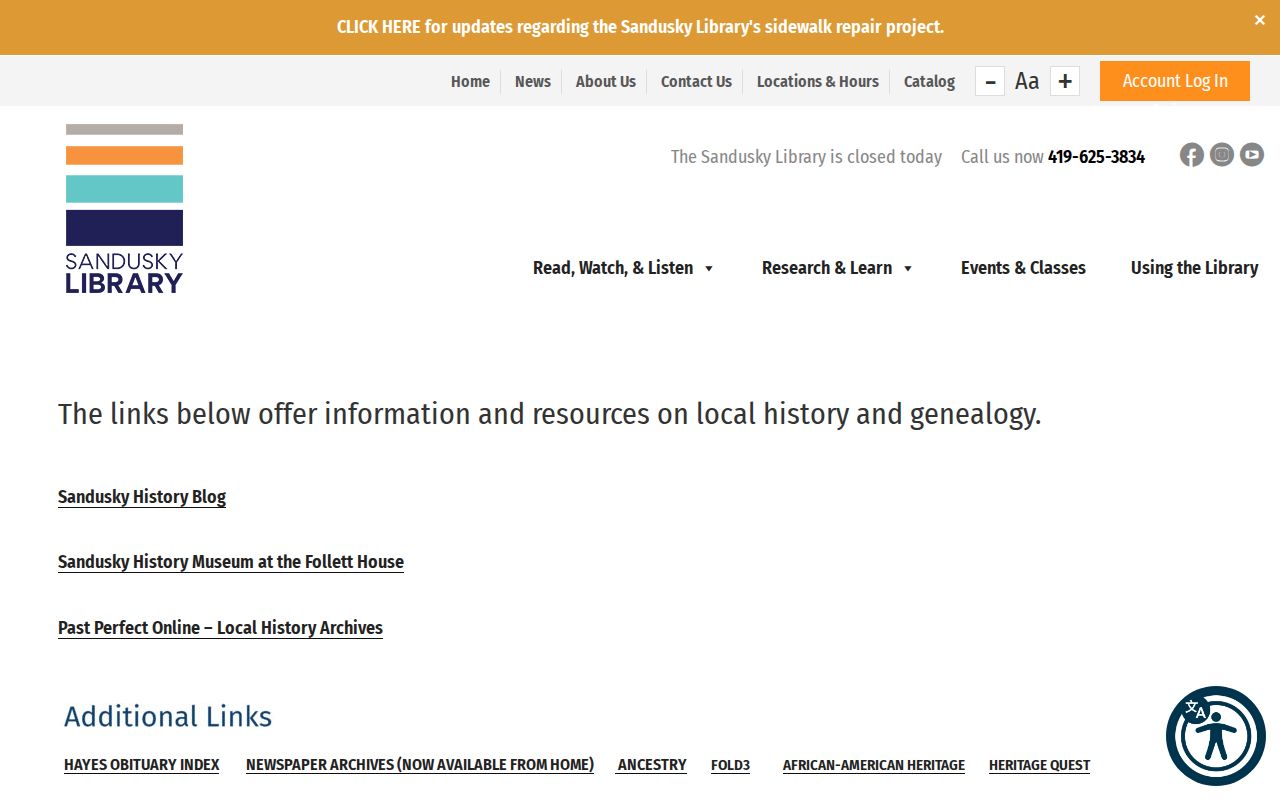
The local-history gateway is a practical starting point for databases and archival directions, while a newspaper notice remains evidence only for its printed date and context.
Sandusky City Directory Cemetery Cross-Checks
An obituary or burial lead can help distinguish similar names in old directory work. The City of Sandusky's Oakland Cemetery page confirms an online burial-record search and provides a telephone fallback at 419-627-5842 for a no-result question. The City-linked search exposes Last Name, First Name, Date Interred, date-range choices, Section, Lot, and AKA Search. The Library also has a public computer for the Oakland Cemetery Interment Record Index.
The Library directs obituary researchers to the Rutherford B. Hayes Ohio Obituary Index, which describes more than three million names from Ohio newspapers and related materials, with particular strength in Northwest Ohio. Its live filters and item-level coverage were not verified. Use a returned index lead to locate a local newspaper, cemetery, vital, or probate record rather than treating an index line as the full record.
Sandusky Directories Need Dated Maps
Historic streets require local geography, not a modern map assumption. The Erie County Historical Society describes the 1818 plat as a rectangular grid centered on Washington Square. It also explains that Water Street was once the shoreline and that later fill, railroad construction, and Shoreline Drive changed the waterfront relationship. A nineteenth-century directory or map may therefore describe a setting that a current parcel screen does not show.
The Sandusky Sanborn resource is a 93-sheet set dated 1905 and republished in 1955. It gives block and building context at its stated dates. There is no verified citywide former-to-current street-number crosswalk, so retain a dated map, PIN or legal description, or recorded document before suggesting address continuity.
Sandusky City Directory Archive Rules
The Archives Research Center's material does not circulate, and its research rules protect fragile holdings. Researchers use a request form and photo identification, keep food and drink away, remove bags from research tables, work with one box or folder at a time, preserve original order, and use pencil rather than pen. Cameras or scanners need advance express permission. The Center can answer limited mail inquiries, but it cannot undertake extensive written research, so a narrow surname, year, and street request is more workable.
Limited research copies are available. The published schedule lists $3 for a research photocopy of an obituary or article, $10 for an 8 by 10 reproduction, $20 for 11 by 17, $30 for 22 by 28, and $10 for an emailed or CD digital image. Orders above $25 may be referred to an independent researcher because of staff availability. Publication or broader use requires written permission and, where appropriate, copyright-holder approval.
Browse the Sandusky PastPerfect Online catalog for archival images and artifacts.
PastPerfect can point to a dated collection item, but its live field labels, filters, coverage, and result details were not verified during the research review.
Sandusky Directory Collection Timeline
The dated milestones below help separate the printed-directory record from the institutions that preserve it. Each event has its own source and scope.
| Date | Documented local record milestone |
|---|---|
| 1855 | W. D. Root's first annual Sandusky directory is the earliest identified local volume. |
| 1895 | Sandusky Library was incorporated on November 5. |
| 1901 | The Carnegie library building was dedicated. |
| 1915 | The W. M. Lawrence & Co. volume printed the address-organized street census. |
| 2004 | A Library expansion incorporated the old Erie County Jail. |
Archives materials follow Library research and permissions procedures. City and county public-office records follow the Ohio Public Records Act, ORC 149.43, through their named custodians. The two systems can support the same historical question without becoming the same record series.