
Sandusky Resident Lookup Records
No single office keeps a file on every person tied to Sandusky. Pick the record that answers your actual question. Keep its date with the result. Keep its limits there too. An Auditor parcel entry describes property, not every resident at an address. A court docket speaks only to one case. A printed street directory places a name in a single year. Working within those boundaries beats treating one online hit as the final word.
| Record route | Question it can help answer | Custodian or source | Access boundary |
|---|---|---|---|
| Parcel and transfer record | Assessed parcel identity and recorded-property lead | Erie County Auditor Property Search and Parcel Viewer | Physical and tax-mailing fields are different. |
| Voter registration | Statutorily public registration information | Ohio Voter Lookup | Protected registrations and address rules apply. |
| Court file | Case, ticket, or party-name lead | Correct Erie County or Sandusky court | Online data can lag; records may be sealed. |
| Vital event | Certified event-record request route | Health Department, Probate, or Clerk | Date and record type decide the custodian. |
| Dated local source | Historic name or address connection | Sandusky Library Archives Research Center | A dated source does not prove a current connection. |
Property questions should start with the Auditor or the Erie County Parcel Viewer. Case and vital-event questions belong with the court or vital custodian instead. That distinction matters. A deed name or an old directory entry is not proof of present residence. Reading it that way leads straight to bad conclusions.
Sandusky Courts Verify Names
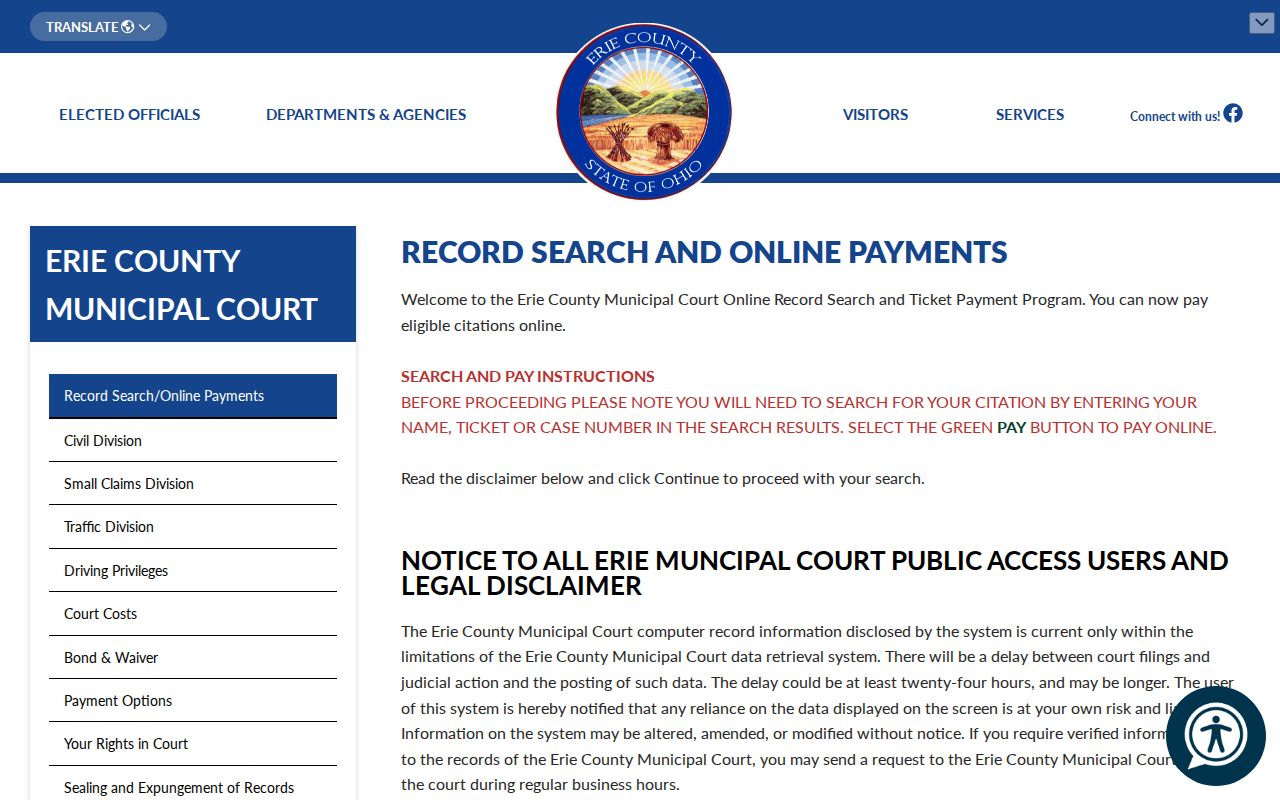
A court name check starts with the right court. Three separate systems exist. Erie County Common Pleas records sit in the Clerk's Public Information Case System, while Erie County Municipal Court and Sandusky Municipal Court each run their own. The Erie County Municipal Court search takes a name, ticket number, or case number after its disclaimer. Its notice is blunt. Web data can lag a filing or judicial action by at least 24 hours, sometimes longer. The court itself is the safe route during regular hours.
The Erie County Municipal Court record search appears below. Use a ticket number when available. The page confirms an eligible citation route. Its landing screen shows no full docket inventory.
| Available search or result detail | What the public page establishes |
|---|---|
| Name | An available citation-search key, but not enough by itself to resolve a same-name result. |
| Ticket Number | A more specific search alternative when it is known. |
| Case Number | Another explicit search alternative for the court record. |
| Eligible citation | The result may offer a green Pay action after a record is found. |
| Current-data notice | Posting may lag filing or judicial action by at least 24 hours or longer. |
Any name result deserves a second anchor. Public results carry gaps. Juvenile, adoption, sealed, expunged, and protected material may be missing or redacted. The Sandusky Municipal Court CaseLook search posts its own disclaimer and delay warning. Check any hit there against a case number, court division, filing date, or party role. Keep its results separate from an Erie County Municipal Court result, since similar court names do not make them the same database.
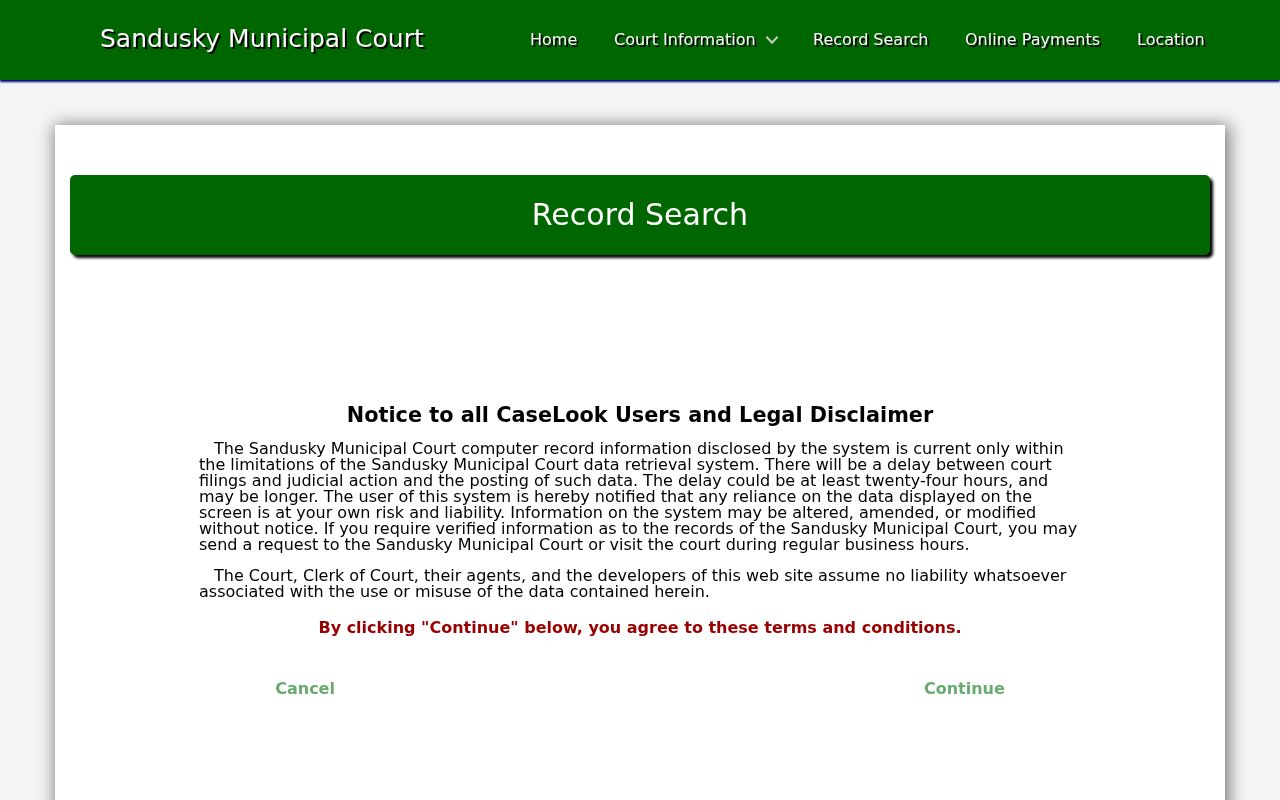
The City court screen is only a lead. A certified copy comes from the court that handled the action. Provide the case reference, parties, approximate date, and copy type.
Sandusky Voter Lookup Fields
The state voter lookup is an individual search. It is not a citywide name-and-address list. First name, last name, and county are required. A Street Name selector may appear to narrow an initial match. A prior surname or an old county can help locate the right registration, but corrections and official questions go to the Erie County Board of Elections.
| Visible field | Use in a Sandusky name check |
|---|---|
| First Name | Required individual lookup key. |
| Last Name | Required individual lookup key. |
| County | Select Erie County before submitting. |
| Street Name | Conditional refinement after an initial result. |
| Submit | Runs the state lookup. |
ORC 3503.153 sets out which elector details may appear online. Confidentiality rules and protected-address programs still limit the result. A voter hit is not an address confirmation. It should never be used to work around a protected registration.
Sandusky Vital Record Dates
For vital events, the date drives the request. Erie County splits its records at December 20, 1908. Births and deaths before that date sit with Probate Court. Later birth and death records start with the Erie County Health Department Bureau of Vital Statistics. The Ohio Department of Health route is another option. Marriage records stay with Probate Court. Divorce decrees come from the Clerk of Courts. These paths cover specific records, not shortcuts around adoption or protected information. The Erie County Probate Court records portal is one local starting point. It serves probate and marriage questions. The portal publishes no field-label or coverage detail. A name-only web result cannot be promised.
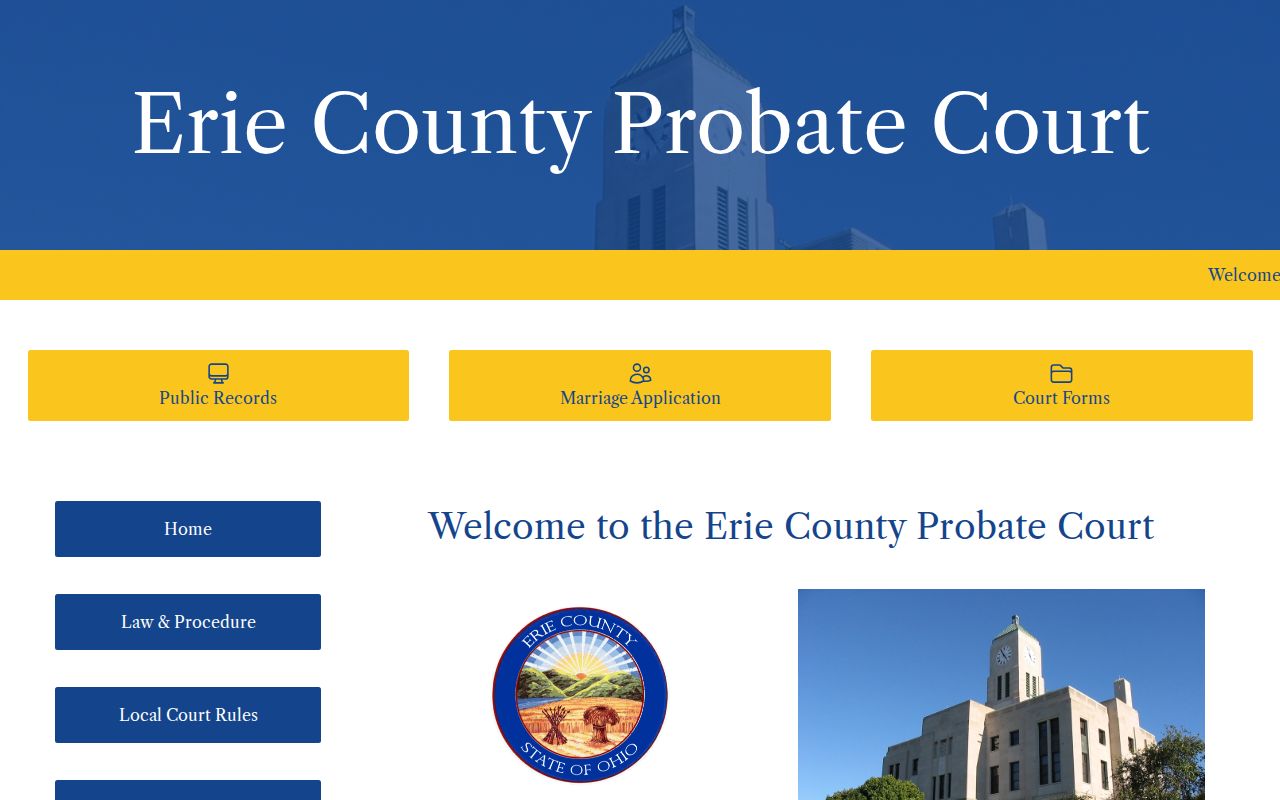
For later birth or death copies, the Erie County Health Department posts a certified-copy route. Confirm the current form and delivery channel. Verify the total cost before payment, since record type and statutory add-ons can change the request.
Verify a Sandusky Resident Match
Anchor any name to two stable, non-sensitive clues. A spelling variation, a date, a court number, a parcel legal description, a recording reference, or a street address from the same period all work. Record the source URL and the search date. Evidence eras differ. A 1915 street directory entry and a modern parcel view are different animals, even when the names look alike.
- Write the name as found, along with initials, prior surname, and an approximate place or date.
- Choose the custodian that holds the record type, such as a court for a case or the Auditor for a parcel question.
- Compare two stable details before considering the returns a likely match.
- Preserve the result date, source, and any stated coverage or delay warning.
- Ask the custodian for a copy or in-person review when the online record is incomplete, old, or uncertain.
- Docket
- A court's running list of filings and activity in one case.
- Index and image
- An index points to a record; an image is the scanned document itself, when the custodian makes one available.
- Certified copy
- A copy issued and authenticated by the office that keeps the original record.
Keep the name variant, date, and record reference together. That small trail lets you revisit a result later without quietly turning an uncertain lead into a confirmed identity.
Sandusky Report and Custody Limits
A report or custody screen answers a narrower question than a name check does. The Erie County Sheriff's report search offers three ways in. You can search by report number, by party name, or by date and report type. Results carry a Report Date and an Upload Date. The depth of the historical coverage is not stated. A name hit alone tells you little. To tie a report to a particular person, you need the record date. A reference helps too.
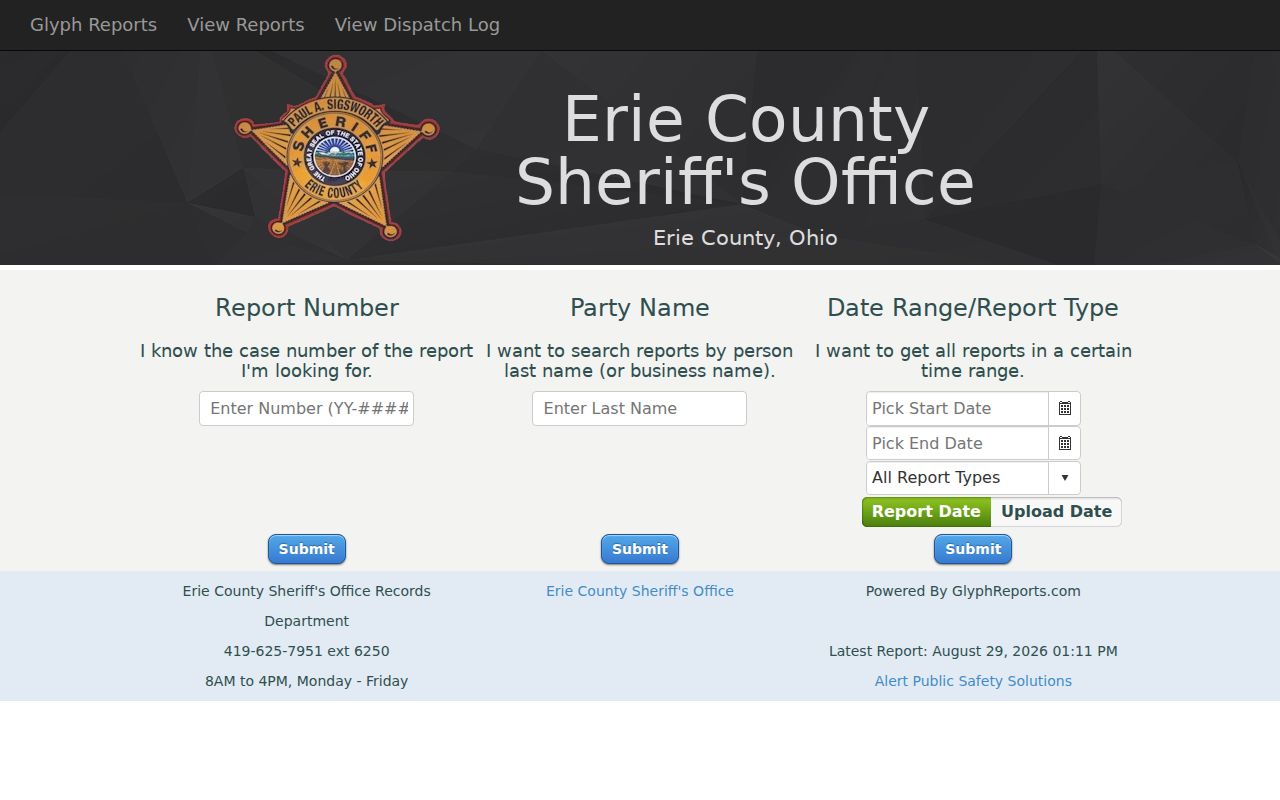
The report-search image shows a source-specific route, not a general identity record. Request a report through the Sheriff's records channel. Bring the most precise report number, date, and party name you have.
The Erie County jail roster is likewise a snapshot. It is not a court history. The roster lists charges, court, disposition, bail, book date, and release date. Every one of those fields can change as a case moves.
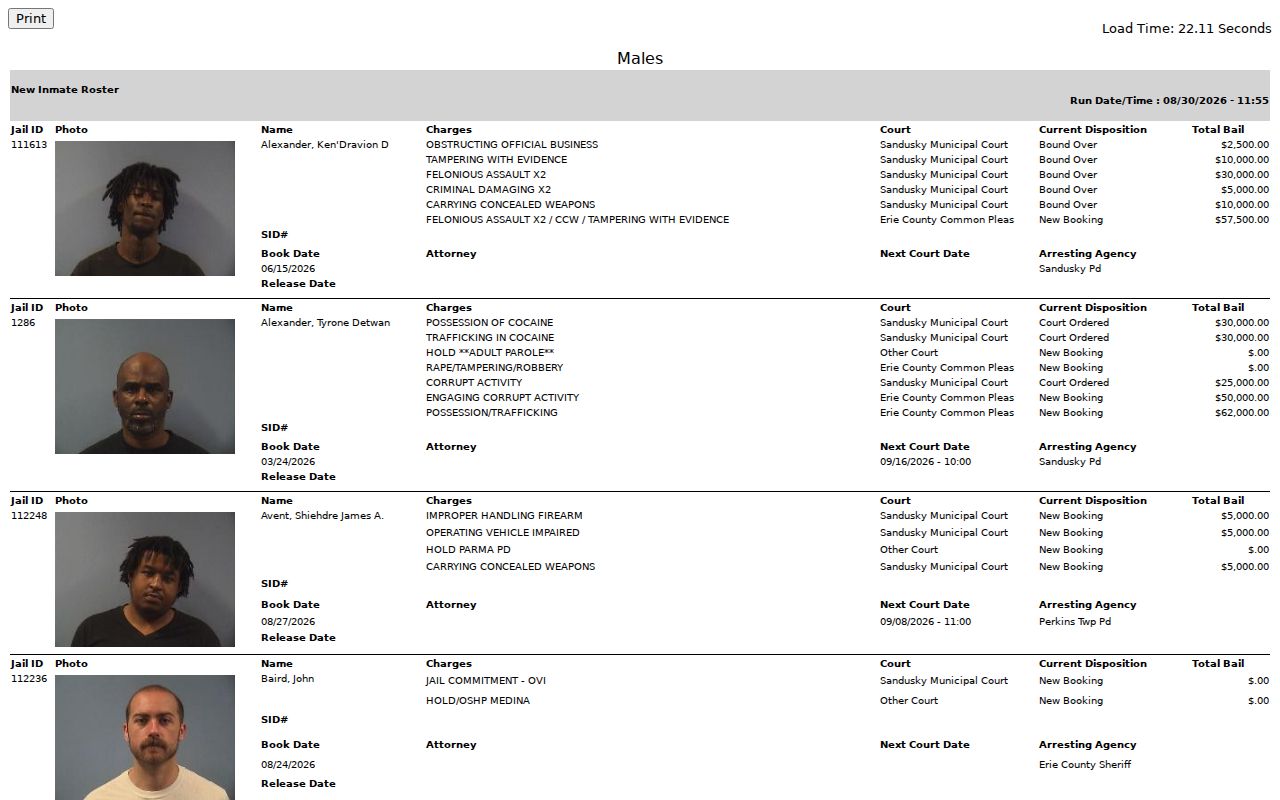
A missing name on a custody screen proves nothing about the court record. Use the proper court route for a case question. Respect seals and privacy rules throughout.
Sandusky Historic Identity Leads
A dated local source beats a present-tense guess every time. For old questions about who lived where in Sandusky, the Sandusky Library Archives Research Center is the strongest starting point. Its shelves hold city directories reaching back to 1855, with some gaps. Local newspapers on microfilm run from 1822 onward. There is also an on-site interment index for Oakland Cemetery. Staff can work with far more precision when a request pairs a surname with a year and a street. So give them that narrower frame instead of a bare name.
A second channel comes through the City itself. The Oakland Cemetery route on the City site offers an online burial search. A phone option sits behind it. An obituary, a cemetery entry, a directory listing, and a probate lead can each help separate residents who share a name. Just remember what each record is. It is evidence tied to its own date and its own purpose.
Sandusky Name-Match Traps
Same-name hits show up constantly across property, court, voter, and archive systems. A property result may reflect a deeded owner. A court docket names a party. A state entity filing may list a statutory agent. None of those roles alone proves present residence or ownership beyond that record's scope. Separate each possible identity. Wait for a second stable field before linking anything.
Ohio's business and credential systems can answer a narrowly defined affiliation question. The Secretary of State business search returns entity filing information. The Secretary keeps no owner or officer lists. A credential record, in the same way, documents a license role. Keep the entity or credential number, jurisdiction, displayed status, and date with each result. Do not merge it into a personal profile.
Note: If a record is ambiguous, sealed, redacted, or protected, stop the search and ask the named custodian about the lawful access route.
Sandusky Records Access Limits
The Ohio Public Records Act, under ORC 149.43, lets you request an adequately described public record from the office that keeps it. The office does not have to create a new record or do legal research for you. Make the request specific. Give the record type, the indexed name, an approximate date, a case or parcel reference, your preferred copy type, and how you want delivery. When public and exempt content sit in the same record, the custodian applies the exemption or redaction rather than releasing protected material.
Lawful use. Use Sandusky records for lawful personal research, family history, or a specific public-record question. Do not use a result to stalk, harass, intimidate, or reconstruct a protected person's information.
An online result that comes back incomplete is not the end. Ask the named office whether it holds the relevant date range. Ask whether inspection, a copy request, or an in-person review is available. That is the right fallback whenever a screen shows a gap.
Sandusky Protected Address Stops
Safe at Home gives eligible Ohio participants a substitute address. It works for voter registration, government mail, and related official use. Shielding Ohio's Protectors is separate. It redacts addresses for qualifying public-service workers and certain family members. Neither program justifies rummaging through unrelated records for fragments that might expose a protected address.
ORC 149.45 also sets out an online-record personal-information removal process where its circumstances apply. One custodian's response erases nothing held elsewhere. And a public record never overrides motor-vehicle, vital, court, or protected-registration limits. Sound Sandusky verification practice is simple. Keep only the record evidence your question needs. Defer to the custodian whenever a confidentiality limit appears.